
On the subject of WQ, I have an article on blogging published in this month’s edition. If you’re a Queensland writer, I recommend joining the Queensland Writers Centre – lots of useful information in the newsletter each month, including competitions and opportunities, as well as thoughtful and up-to-the-minute articles. Happy reading!
You’re the voice
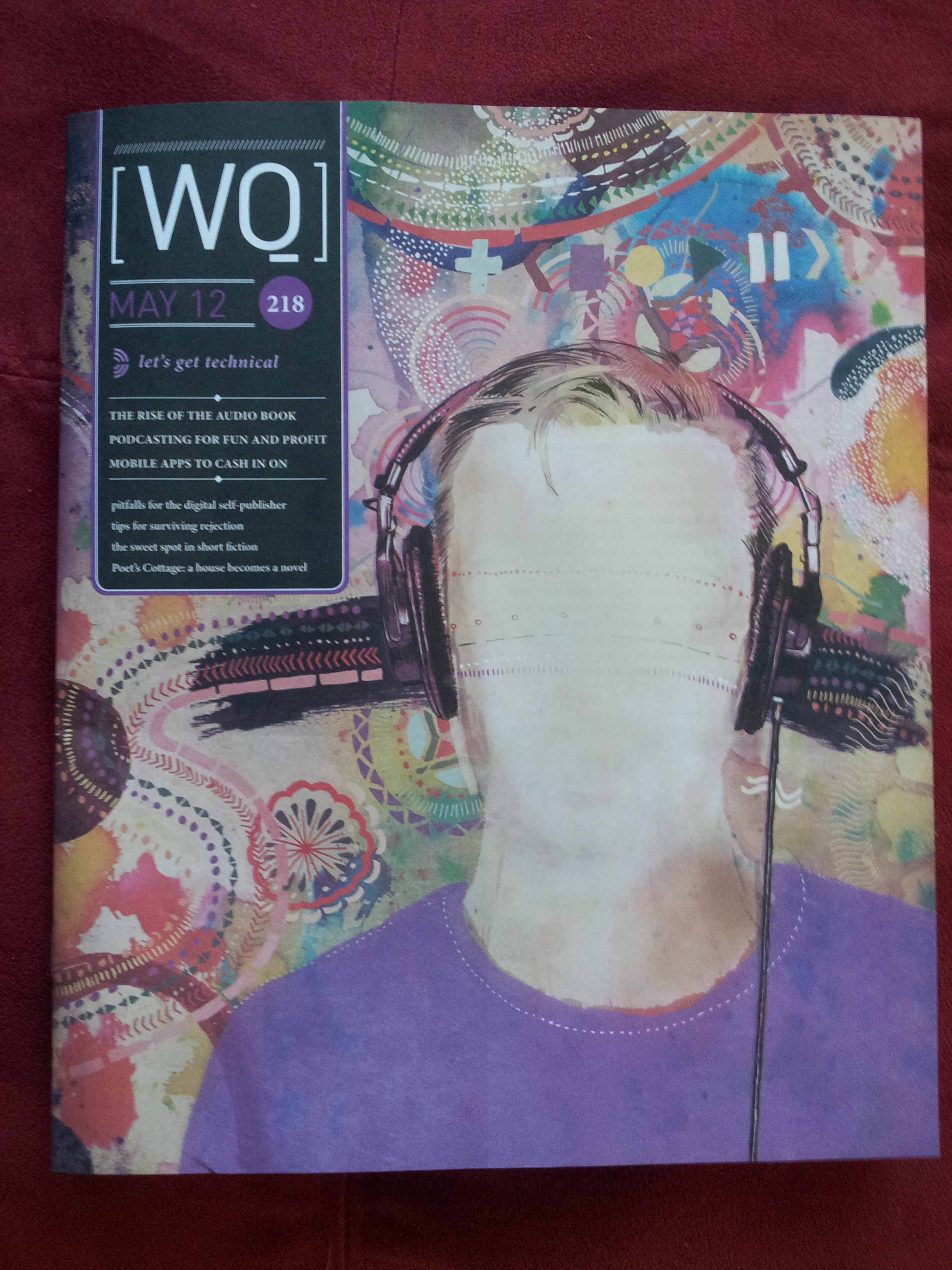 There’s an article by Tim Kroenert in this month’s WQ magazine, about audio books. Tim recommends thinking ahead about the possibility of your novel being recorded, and taking steps to retain creative control over this form.
The article reminded me of an experience I had last year, listening to authors read their own works aloud at the Griffith Review Christmas party. These were stories I’d already read on the page, but hearing them read created a whole new relationship between the text, the author, and me. The stories became more immediate, more alive.
As writers, we’re often advised to read our work-in-progress aloud, particularly to check whether dialogue sounds authentic. But it’s not just dialogue that needs to be tongue-friendly. The process of reading is essentially one of talking to ourselves – “reading aloud silently”. When reading aloud, I run out of breath if a sentence goes on too long without a comma or full stop. Silent reading doesn’t physically dictate to the breath, but psychologically I’ll still lose the thread of a poorly-punctuated sentence. Similarly, when reading aloud I’m likely to trip over a phrase with too many incompatible consonants too close together. When I’m reading silently, a phrase like that feels clumsy, and will distract me from its meaning.
Some people write by speaking the story aloud into a recorder, then coming back and turning it into written text using voice-recognition software, a transcriber, and/or their own transcription skills. They edit as they transcribe, and/or edit the transcription. I can’t imagine myself writing like this – maybe it’s a technique for extroverts. But I certainly find reading the draft aloud is a valuable tool when rewriting. It’s much easier to hear when I’m repeating myself, or giving more information than is needed.
I once arranged for a group of actors to read my husband’s draft screenplay, while he listened and took notes. He also recorded the reading so he could listen again later. This technique has obvious advantages for a screen or stageplay, which will eventually be performed by a number of people. I suspect that, even with fiction, having someone else read your work aloud sharpens your editorial ear. Like most people, I cringe at the sound of my own voice, but recording and playing back your own work is another option in the absence of a willing “performer”.
And if all these sound like good ideas you’ll never actually get around to using, consider that when you win a competition, you may be asked to read aloud from your work at the awards ceremony. Why not get in practice now?
Filed under Writing Process
Leaving is fine – it’s coming back that hurts!

I read somewhere that, in ancient Greece, writers were advised to leave a “finished” piece of writing alone for nine years before coming back and editing it. Nine years might be going a bit overboard, but this is still common advice: write it, leave it alone, come back with fresh eyes and edit like it’s someone else’s writing.
I endorse this advice whole-heartedly. (You can hear the “but” coming, can’t you?) I left the first draft of my novel alone for a full three months over Christmas, and wrote a novella. Now I’ve left the novella alone for three weeks while I worked on my PhD confirmation.
Here’s the “but”. When you get back to the piece of writing you left alone, you may have one or more of the following reactions:
- This is utter rubbish
- What was I thinking?
- I can’t remember why I wanted to write this in the first place
- It really is rubbish
- Aaaaaaarrrrrrggggghhhhhh!
Before you can rewrite, you need to do a few things:
- Reconnect with why you wanted to write this, what got you fired up about it
- Identify the strengths – which parts do work, what aspects have merit?
- Ask yourself whether there’s one overriding problem that’s causing your negative reaction. That’s probably the place to start reworking
For my novel, surprisingly, I did have to reformulate why I cared. Spending a year on the first draft had me bogged down in technical issues; I knew I was passionate about the story, but couldn’t have told you succinctly why. I think I can now.
Identifying the strengths wasn’t too difficult – I like all the characters, still love the setting, the dialogue and description are generally strong, and the second half flows quite well though it’s a bit rushed at the end.
The overriding problem was easy to identify, too, because my five test readers all said the same thing: they couldn’t get a handle on the protagonist. The rewrite must start with letting readers into the protagonist’s head in a way that enlists their sympathy. My problem here is the balance between trusting the reader to do the work, and giving them enough information to work with. I’m also struggling with the idea of “show don’t tell”. With internal monologue, telling is showing if you do it right – but despite reading many many examples of great writing, I still can’t work out how to do it right. Advice, anyone?
The novella is a little different. I know why I’m passionate about telling the story, so that’s not a problem. I’m having trouble identifying strengths in the writing because I’m overwhelmed by what’s wrong with it. The main problem is something to do with pace and momentum in combination with tension. The writing seems to gloss over the story; too much happens too fast with not enough tension or emotional engagement. The result is a story that feels glib and pat, when it should feel complex and powerful. Individually, the events of the plot are believable. The characters are realistic. But something about the way I’m telling the story is failing to do justice to the characters and what they go through from beginning to end. I need to find ways to deepen the reader’s engagement with the characters without slowing the story to a plodding pace. I suspect it needs to be significantly longer – too much happens in 19,000 words – but the last thing I want to do is create “padding”. Again, I’m very open to suggestions and advice from you, wonderful fellow-writers :-).
Filed under Fiction Techniques
Extending and Advancing
 Once again, Improvisational Theatre waves its hand from the back row – “Miss, miss!”
“Yes Impro, do you have something to contribute to this discussion on storytelling in flash fiction?”
“Extend and advance, Miss!”
Ah yes.
When I was an improviser, I was enchanted by Keith Johnstone’s concept of extending and advancing. Extending means staying with “what you’ve got” – elaborating, exploring, going deeper, resisting the pressure to move forward. Advancing means deliberately yielding to the narrative pressure and taking a step.
Inexperienced improvisers tend to rush the story – advance, advance, advance – without investing the time to evoke setting, build character, or enlist the audience’s emotions. Timed impro games (especially 1 and 2 minute games) often encourage this breathless rushing that leaves nobody feeling satisfied.
I think that, for writers, there’s a risk that flash fiction can encourage the same strategy – trying to pack in as much “action” as quickly as possible. However, the best flash fiction I’ve read – like some of the best improvisation I’ve seen – creates a sense of deep engagement, of taking its time, of bringing the reader/audience along.
My favourite improvisation exercise for developing extending/advancing skills is played in pairs.
Person A starts an activity (eg. “going fishing”), and Person B asks “What are you doing?”
A must check, and report what she’s doing right at this moment – “walking”, “breathing”, “sliding the worm onto the hook”, “swinging my rod backwards”.
Then B says “Extend … (that action)”. A lets go of whatever she’s vaguely intending to do in the future (eg. hook such a big fish she gets hauled into the water), and focuses on extending the identified moment of walking, breathing, sliding the worm, or swinging the rod.
All kinds of possibilities can develop out of any of these actions. From “breathing”, for example, A might find herself suddenly struggling for breath, or smell something foul or beautiful and start sniffing the air. A bug might fly up her nose, she might find herself filling up like a balloon, etc. etc.
B observes carefully, and encourages A to extend on her immediate action – “Extend trying to snort the bug out of your nose”. The story gradually develops – it does move forward – but with much more tension, physicality, emotion, and interest, than if A had simply ploughed ahead with the ideas she had in mind. It’s a little like a collected canter in dressage, where the horse is moving forward but in an “intensified” kind of way, because momentum is working against restraint.
After a while, if A starts feeling uncreative in her extending and the story hasn’t reached a satisfying conclusion, B might say “Advance”. This gives A permission to let something new happen. The sense of release from the intensity of extending usually results in quite a big leap or twist. For example, since A has blown up like a balloon and is floating helplessly, the enormous fish might mistake her for a fly and leap up out of the water. This advancement is immediately reined in by the instruction to “Extend” (eg. “What are you doing?” “Being eaten by the fish!” “Extend being eaten”). And again we get a rich, satisfying, entertaining chunk of story.
I’ve noticed most if not all of my favourite flash pieces work the same way as the game Extend and Advance. The storyteller starts us off somewhere, and extends on what’s happening, tiny detail by tiny detail, developing the picture. Then there’ll be a leap, twist or turning point that’s quite dramatic, if subtle. Some stories are two-act (one turning point, maybe half or 2/3 of the way through), some are three-act (one turning point at the 1/3 mark, another around the 2/3 mark or later). After the turning point (advance), the dominant mode might return to extension, but the story usually seems to move more quickly because the details are now invested with new meaning.
Some exercises:
1. Look at several pieces of flash fiction by different authors (I’ve been looking at pieces up to 300 words, but the uses of extending and advancing are usually very clear up to about 1000 words).
Using a couple of different colour highlighting pens, mark each sentence according to whether it’s “extending” or “advancing”.
Notice where the points of advancement occur. Do they delineate “acts” in the story? What impact does each advancement have on what comes after? Does the author then go back to extending, or leap from advance to advance? Are there different degrees of advancement – big leaps versus small but significant ones? How does the author manage extending without becoming boring? How does she manage advancing without leaving the reader behind?
For this exercise it’s great if you can get some pieces you feel “work”, and some you feel “don’t quite work”, and analyse the weaker stories by comparing them with the stronger.
2. Write a piece of flash fiction. Give yourself a time limit (5 minutes). Start with a title, topic or idea (use a prompt from a writing site if you need one). Write the first sentence. Then “Extend” on the first sentence/idea. Extend and extend as long as you can, resisting the pressure to advance the story until you a. reach a satisfying conclusion, b. run out of time, c. start feeling uncreative, or d. have such a good idea for an advancement you can’t resist.
If a., read over the first draft and decide what else the story needs. Did an advancement creep in without you even noticing? Did you extend all the way to the end, but nothing much happened? Is it a good story but a bit “samey” in terms of pace, tone, etc.? Use the concepts of advancing and extending to rewrite.
If b., pretty much the same as for a. Did you reach a conclusion? What does the story need? Go back and rewrite, using the concepts of advancing and extending.
If c. or d., allow yourself to Advance. Now you’ll have to decide whether (and what) to extend. Maybe the path to the end of your story is now in a series of advancements, like stepping stones. When you run out of time, start your rewriting process, paying particular attention to the concepts of advancing and extending.
When you’ve rewritten your piece to your satisfaction, go through the finished story with your highlighters and identify the sentences that extend and those that advance. Ask yourself the questions from 1.
I know this is a very analytical exercise, but it should be quite an informative one 🙂
Filed under Fiction Techniques, Narratology, Writing Exercises
“The Internet is our friend”

On Wednesday I attended the Queensland Writers Centre presentation “To Market To Market: Pitching to Publishers”, at the Somerset Celebration of Literature (thanks Amy for the tip!)
The Celebration is geared towards young people interested in literature and writing, but there are also various sessions and events for adult writers of children’s and YA literature.
Wednesday’s session was facilitated by Sarah Gory from QWC, and featured children’s author Tristan Bancks and YA author Belinda Jeffrey.
The authors talked quite a bit about their redrafting processes, how they choose test readers to give them feedback, and what kinds of things happen during redrafting (eg. changing from third person to first person POV, or vice versa, might unlock a number of problems at once). There was discussion about what an agent does, how to approach publishers, the need for researching your specific niche in the industry, dos and don’ts of submission, and author platforms.
What interested me most were the questions asked by some seminar participants, to which answers are readily available online, through a plethora of resources. I don’t mean to sound supercilious about this – I’m no digital native myself. But I was surprised to find writers unaware of the online resources available to them with just a click or two.
For example, appropriate word lengths of books targeted at specific age groups. Guidelines are readily available on the websites of major publishers (eg. Pan Macmillan, Penguin, Scholastic, Allen & Unwin, Harper Collins – see Links page). You can also find advice and discussion through any number of blogs and forums just by Googling the topic. I looked up “word count age groups”, “word length age groups”, and “novel length”, and got similar sites each time (eg. Literary Rambles, Kidlit, Novel-Writing-Help). Most of these are blogs by authors, agents or publishers, or specialist resource sites for writers, so the advice is up-to-date and useful.
Then there was a question about how to write a query letter. Sarah offered the QWC Writers Guide on this topic. There are many of these Guides on the QWC site, very helpful, and not Queensland-specific so they should be useful to any writer (certainly any Australian writer). But there are also many other sites where you can learn the accepted structure of a query letter, dos and don’ts of querying, even have your query vetted by an agent (the amazingly generous site QueryShark, for example).
Why are so many writers seemingly unaware of these resources? Are many people still intimidated by the internet? Is it the sheer volume of available information that seems overwhelming? Or are writers wary of wading into these deep waters, knowing they’ll be tempted to swim around all day when they really should have stayed on the island keeping their notebooks dry and writing? (I know – me too).
I have to recommend Writers Digest’s Best 101 Websites for Writers. They make a new list annually, it’s divided into handy categories, and I’ve been delighted to find many sites on there that I’d already discovered through trial and error. I do try to add new links to my Links page if I think they’ll be helpful to others, but I can’t always keep up. The Writers Digest list is a good starting point.
Filed under Useful resources
Where’s your notebook?
 Writer John Gregory Dunne allegedly said that always having the means at hand to record an idea is what makes the difference between being a writer, and not.
I was amused (and impressed) to learn recently that poet Ross Clark keeps one notebook in the car, another by the bed, another in his back pocket… Wherever Ross is seized by a poetic urge or image, he has the means to write it down.
Some writers carry a voice recorder around for this purpose. Now that everyone has a Smart Phone, we all have that “means”.
My problem is that I never get round to downloading, or even listening to, the ideas I’ve “noted” on my voice recorder, re-reading the lines I’ve sent myself as texts, or reviewing those random jottings in the notebooks. New ideas are constantly taking their place. I fondly imagine that dedicated notebooks are a step in the right direction – I have boxes of old diaries, lecture books and scraps of paper which I’ve kept only for the phrases and fragments dotted through them in margins and on back pages. The odd napkin or beer coaster I’ve retained for the same reason. Have I ever revisited, let alone used, a single one of those fragments?
Not as far as I know. Not one.
However…*
I’d like to think what’s at work here is a process rather than a product. By writing the idea down, I process it. I articulate a concept, and explore it a little further than I might otherwise. Perhaps an idea that would have resumed swirling formlessly round my unconscious moves through to a more conscious place, to be reproduced later although I’ve forgotten I ever wrote it down.
I could test this plausible hypothesis by going back through those old notebooks to see whether the fragments have since made their way into my “formed” pieces of writing.
But who has the time? 🙂
*Yes, I do like ellipses, they are graceful and beautiful in their balanced and regular combination of dots and spaces, they express the way my mind works, and I will continue to use them until my publisher tells me not to, and then I will desist only for the duration of the particular book in which the publisher objects to their appearance, and this is my declaration and stated intention, so there.
Filed under Writing Process
What Writing’s Like
I’ve just realised one of the reasons I find writing so physically tiring. It’s not just about sitting up at the computer and looking at a screen (usually I hand-write new stuff in a notebook, lounging as comfortably as possible on the couch, and only type it when my manuscript draft gets too messy to read). When I’m typing I do make the effort to get up and move around, but I hadn’t realised I’m physically involved in my writing beyond the act of typing.
I’m currently writing a novella that alternates between the first person points of view of two characters, a fifty year old male professor and a twenty-seven year old female postgraduate student. I suddenly noticed that I take on the physicality of the character when I’m trying to write in their voice. It’s probably not something you’d notice from the outside, though I think I sit up straighter when “being” the professor. But in my body – in my chest, neck, stomach – I can feel different tensions, exactly as if I were singing or acting. Weird! Does anyone else find the same?And what about when reading? Now I’ll have to pay attention, and see whether my body unconsciously adopts the physicality of characters I’m reading about.
This observation fits nicely with something I was thinking yesterday afternoon, about what writing is “like”. For me it’s definitely like sculpting – when I’m nutting out the story in my head, or describing it to someone else, my hands push and pull and squeeze and smooth the air, as if I were working clay. It’s also like listening to music: I can feel some inner part that sits very still and “listens” to the rhythms and melodies, not just of the words but of the ideas underneath.
Then there’s the sense that it’s like weaving, again with the hands, or maybe tapestry – the characters and themes are threads, that need to be woven together to make beautiful patterns, and the threads need to be held and pulled with just the right amount of tension. Then again, it’s like dancing – a skip here, a gesture there, a lot of ground to be covered gracefully, a turn to be made on the spot.
And now I see that it’s also like acting, and singing, and speaking poetry. Who knew we were doing so much exercise when we sit down to write? 🙂
What other art forms, or other activities in general, is writing like for you? I’d be really interested to know if writing feels like something else you do regularly (eg. if you’re also a painter, does it feel like painting?), or something you hardly do at all (I haven’t sculpted with clay for years, but that’s the first physical sensation that occurs to me when I try to describe what writing feels like).
Filed under General
Promises, Promises
 In The Fiction Editor, the Novel, and the Novelist, Thomas McCormack talks about making promises to the reader. Of course we hear this terminology all the time, but McCormack gets into a fairly technical explanation of what’s entailed in making and keeping such promises.
I was intrigued by the idea that a reader keeps turning pages, not so much because of what she’s reading right now, but rather what she’s being promised is still to come. Like the smell of coffee or the anticipation of Christmas morning, a promise can be so much more delicious than any reality. The reader therefore reads in a state of pleasurable expectation, and so long as reality doesn’t actually disappoint, she’ll finish the book having had a delightful reading experience.
I’m wondering if there’s something too stolid about the way I usually write, which is focussed on what I’m delivering on any given page, rather than what I’m promising.
McCormack talks about “prelibation” (I do love a good neologism!) It translates as something like “foretaste” – tasting in advance. McCormack says that the reader has “salivancy” – an appetite, a craving produced by the text – and the author must know both how to elicit this craving and how to satisfy it. Prelibation is the author’s intuition about what will satisfy.
“Implied prelibation” is when the text has set up an obvious requirement. Virginia Woolf praised Jane Austen for never failing to supply the “obligatory scene” – the scene we have to have. In a whodunnit, there must be a scene in which the detective reveals who the murderer is. Usually there must also be some kind of confrontation with the murderer – don’t you feel cheated when it turns out the murderer has been killed, or has run away to reappear in the sequel, without leaving so much as a taunting note?
I’ve realised there’s an obligatory scene missing from my current novel. Two characters who’ve been in conflict for two-thirds of the book make up awkwardly over the phone because there are larger issues at stake. This just isn’t good enough: the reader will be “salivating” for a proper showdown, which I’m obliged as the writer to supply. Implied prelibation is at work.
“Unimplied prelibation” is more subtle. The reader doesn’t know what she’s expecting next, but she’s expecting something. The writer’s responsibility is both to whet these inchoate appetites, and then to satisfy them with surprising and gratifying details, scenes, dialogue, etc. That’s writing, you say. Yes, but maybe it’s a common mistake of the novice writer to slave away, trying to deliver surprising, gratifying, original, amazing and beautiful words on the page, but not paying enough attention to the creation of expectations. The set-up, the promising.
The idea of promises is related to – possibly the same as? – tension. So that this post doesn’t go on forever, I’ll just look at two examples of the kinds of promises a writer can make, or tensions he can set up.
Here’s the first one-third of the first line of Jeffrey Eugenides’ The Virgin Suicides: “On the morning the last Lisbon daughter took her turn at suicide – it was Mary this time, and sleeping pills, like Therese – …”
What are you asking yourself as a reader? How many Lisbon daughters were there? (clearly at least three, sounds like more). How old were they? (the title and the fact they’re described as “daughters” sounds like they were very young) Why did they attempt suicide? Under what circumstances? How? (since Mary and Therese used sleeping pills) Did any survive? (the word “attempted”) Does Mary survive? Why are we being told this story? The author is promising to explore all these questions, if not necessarily to answer them. We can be pretty sure of finding out how many girls, their names, their ages, the circumstances, the methods, the outcomes. We expect to learn something about the Lisbon daughters, individually and as a family. We can be certain the “why” question will be asked, but we sense from the tone that we’re not being promised an answer, and this is a source of tension.
In the second sentence we get the information that the medics were, “as usual”, moving much too slowly “in our opinion”. The reader is promised something very unusual – a plural first person narrative point of view: in effect, a chorus. Reviewers have noted that the first paragraph of this novel also promises the setting (suburban America), the tone (“wry and voluptuous with glittering black jokes carried along like seacoal by the smooth melancholy swell”), and the idea that there is something allegorical about this story, that it takes place more in a mythic realm than a realistic one. These are all interesting promises, and we read on with a strong sense of curiosity to see where the writer will take us.
A different kind of promise is offered in Justin Cronin’s The Passage, through the structure of the book. Again there’s a mythic note struck at the very beginning, telling us “Before she became the Girl from Nowhere – the One Who Walked In, the First and Last and Only, who lived a thousand years – she was just a little girl in Iowa, named Amy”. The first chapter goes on to tell us briefly and fairly realistically about Amy’s early childhood. The second chapter consists of emails between Jonas Lear and Paul Kiernan, concerning mysterious but horrific events in a Bolivian jungle. The third chapter begins in a prison for men sentenced to death, and focuses on inmate Anthony Carter. Halfway through this chapter we jump to a federal agent, Brad Wolgast, driving along a Texan road reminiscing about his childhood. The promise is that all these people and storylines are moving into alignment, that they will come together and set in motion other trains of events.
Promises, tension, mystery, suspense. A writing exercise? Ask a trusted reader to look at the first paragraph of something you’ve written. Ask them to tell you as they go along:
1. What questions am I asking as I read this?
2. What do I expect from the rest of the story?
Leave the questions as broad as that – see how much they can tell you about the possibilities opening up in their mind, stimulated by your words on the page. Take notes – do any of their questions and speculations surprise you? Do they imagine a whole storyline worlds away from what you’ve actually written? Or do they struggle to articulate any sense of anticipation or curiosity? (in which case, you might want to reword this opening para).
If you’re very brave, you could allow them to go on reading, and describe for you as they go along which possibilities are opening out or collapsing, and whether they’re happy with the realities that take their place.
Filed under Narratology, Writing Exercises
A Cage in Search of a Bird
Here’s a lovely peer-provided service: UK writer Alice Slater shares with her fellow writers upcoming competition and submission deadlines, among other fun things. She’s very diligent at searching these out (me I’m a bit more erratic, but will share things when I find them!)
Alice blogs at:
http://acageinsearchofabird.wordpress.com/
Filed under Useful resources
Relative status of characters
I used to be an improviser. I started with Theatresports, then branched out into other forms of performance impro. If you have a good coach, you can learn a lot about storymaking through theatrical improvisation. (If not, you’ll just learn to gag, block, and cheat the audience out of wonderful experiences they don’t know they could have had – but meanwhile back at the point…)
I did have a good coach, in Keith Johnstone of Loose Moose Theatre Company, Calgary, Canada. One of the key story drivers Keith emphasised was status. Improvised scenes for performance tend to be short, so you need a reliable means of engaging the audience and making sure the story goes somewhere. A good way to do this is to play with characters’ status, and we used to play status games to develop these skills.
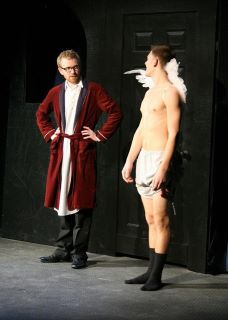
In one game, A starts with high status and B with low (eg. school principal and student, queen and butler, police officer and criminal, etc.) The events of the scene must cause the high status character to lose status, and the low status character to gain status – that is, by the end, the status positions are reversed.
In another exercise, two characters each try to get higher status than the other. For example, A shows off an expensive watch, B claims to have three just like it, A shakes her head pityingly and asks if B is still having trouble with those old delusions, B says not since she invented the world’s most successful anti-psychotic and became a billionnaire, and offers to take A out to dinner to tell her all about it, and so on. Or, the two characters can work to get lower status than the other. Experienced improvisers play a version where they try to maintain equal status – Keith points out that this is what we usually do with our friends.
In writing fiction, it’s quite useful to bear in mind the status relationships between characters. Improvisation scenes often suffer because two characters have the same status (two students, two road-workers, two friends at a nightclub) and although the improvisors are struggling to create a story, they won’t let anything happen that changes the status relationship. Inexplicable torpor or “flatness” in a piece of fiction is sometimes traceable to the same problem.
Status can be conceptualised in terms of power, social standing, respect accorded the character by others. A character whose job or social position might be seen as low status (eg. a swagman) can be high status in a given situation (when he is the only person who knows how to treat a snakebite), or he might just “play” high status and be accorded respect as a result. And, of course, vice versa – the British comedic tradition, for example, is full of put-upon lords and ineffectual politicians who think their position entitles them to a level of respect they don’t actually deserve or get. Humorous effects can be obtained when a character thinks of himself as high status when everyone else sees him as low (common in the commedia dell’Arte), and touching moments can result when a character who sees herself as low status is suddenly elevated to high (a stock technique in romantic comedy, the Cinderella story arc being a classic example).
I’m just beginning a new novella, where the whole story will turn on a change in the status relationship between my two main characters. I think this is very common, but I don’t often hear it discussed in the terms I learnt from Keith Johnstone. So if this idea of status, status hierarchies, status battles, and changes in status relationships, is useful to you in your writing, by all means go ahead and use it. (I was fascinated to discover just now, looking up Keith’s entry on Wikipedia, that his teaching on status seems to be considered his most influential contribution to theatrical storytelling. Pop over and have a look here).
An exercise: read through a piece you’ve written, and analyse what happens to the relative status of the main characters in it, particularly the protagonist. Does the status of the protagonist change – in her own eyes, in the eyes of the people in her world, and/or in the eyes of the reader, over the course of the story? How does that come about? Does another character start out higher status than the protagonist, and end lower, or vice versa? Does a battle for higher (or lower) status drive some (or all) of the action? What are the emotions, conflicts, tensions, which contribute to and arise from that battle? Would more careful attention to status and status relationships enhance the story at all?
Filed under Character relationships
 Fiction Craft